
Lazy Equity vs. Other Passive Income Strategies: Which One Actually Works?

Lazy Equity vs. Other Passive Income Strategies: Which One Actually Works?

Business Loan HelpBuying My First HomeNewsRefinancing My Home Loan
June 29, 2026

Everyone wants passive income. The dream is simple: money flowing in without active effort. But there are dozens of ways to pursue this dream, and most of them disappoint.

Passive income strategies range from dividend stocks to rental properties, peer-to-peer lending to cryptocurrency staking. They all promise wealth-building with minimal effort. In reality, most require significant work, involve substantial risk, or deliver mediocre returns.

So where does lazy equity fit? And more importantly, how does it compare to other popular passive income strategies?

This article compares lazy equity to the most common alternatives, showing you which strategies actually work and why lazy equity wins for most people. By understanding the tradeoffs, you’ll make a smarter choice about your financial future.
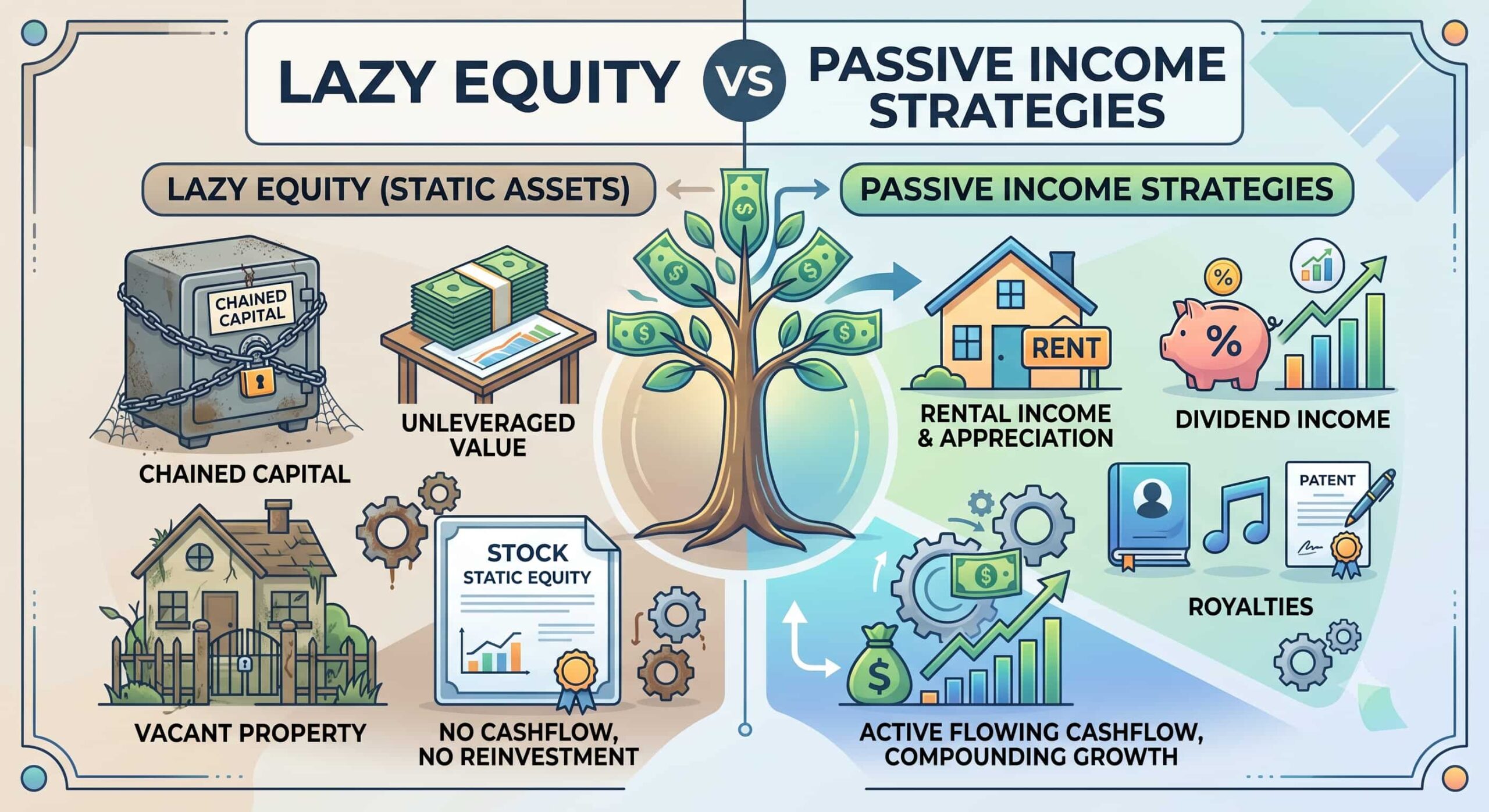
Lazy Equity vs passive income strategies

Passive Income Strategy #1: Dividend Stocks & REITs

The Promise: Buy dividend-paying stocks, collect quarterly payments, watch wealth grow.

The Reality: More complicated than it sounds.

The Good

Dividend investing works. Companies that pay consistent dividends tend to be stable, profitable, and often outperform over long periods. A 3-4% dividend yield, reinvested, creates meaningful wealth over decades.

REITs (Real Estate Investment Trusts) offer real estate exposure without property management headaches. You get portfolio diversification and regular income.

The Bad

Dividend stocks require stock picking. Which companies have sustainable dividends? When will they cut dividends? Most individual investors get this wrong.

Tax complexity increases. Dividends are taxed differently than capital gains. You need to track dividend dates, reinvestment, and tax implications.

Higher fees. If you buy through managed dividend funds, you pay fees that eat into returns. Individual dividend stocks require trading commissions and more monitoring.

Concentrated risk. Owning 10-20 dividend stocks is less diversified than owning an entire market through index funds.

REITs specifically: Tend to underperform equity markets over 30-year periods. You’re taking real estate risk for market returns.

Lazy Equity Comparison

Lazy equity through index funds often includes dividend stocks automatically. You get dividend exposure without the complexity, tax burden, or concentrated risk. You benefit from growth and dividends, diversified across thousands of companies.

Winner for most people: Lazy Equity (simpler, lower taxes, more diversified)

I am text block. Click edit button to change this text. Lorem ipsum dolor sit amet, consectetur adipiscing elit. Ut elit tellus, luctus nec ullamcorper mattis, pulvinar dapibus leo.

Passive Income Strategy #2: Real Estate Investing

The Promise: Buy a property, rent it out, collect passive income while it appreciates.

The Reality: Real estate is semi-passive at best.

The Good

Real estate offers tangible assets, leverage (using debt to amplify returns), and tax deductions. Some investors achieve excellent returns, especially in appreciating markets.

Property ownership creates forced discipline—you must pay the mortgage, forcing wealth accumulation.

The Bad

It’s not passive. Tenant issues, repairs, maintenance, vacancies—these demand constant attention. You’re either doing this yourself (very active) or paying property managers (eating into returns).

High entry costs. You need 10-20% down payment. Most people can’t easily access $50,000-100,000+ for investment property.

Illiquidity. Need money fast? Can’t quickly sell real estate. Your capital is trapped.

Market dependent. Real estate returns vary wildly by location and timing. Overestimating appreciation is the #1 investor mistake.

Concentrated risk. Most property investors own 1-3 properties. If one tenant damages it or the market crashes locally, you’re devastated. Lazy equity owns thousands of properties (through REITs) and equities.

Returns aren’t magical. Historical real estate returns match stock market returns (8-10% annually). You took more effort and risk for the same outcome.

Lazy Equity Comparison

Lazy equity is genuinely passive. No tenants, no repairs, no management. You get real estate exposure automatically (through REIT holdings in diversified funds) plus stock market exposure, all with no effort.

And if you want additional real estate exposure, you can own REITs through lazy equity—the best of both worlds without property management.

Winner for most people: Lazy Equity (truly passive, lower effort, more diversified)

Passive Income Strategy #3: Dividend ETFs & Bond Ladders

The Promise: Own funds that pay high dividends or bonds that mature on schedule.

The Reality: Good for income, mediocre for wealth building.

The Good

Dividend ETFs simplify dividend investing. Bond ladders create predictable income streams. These work well if you need current income (retirement, for example).

The Bad

Lower long-term returns. High-dividend portfolios typically underperform balanced portfolios over 20-30 years because you’re overweighting mature, slower-growing companies.

Inflation risk. A 4% dividend sounds good until inflation erodes purchasing power. Your income doesn’t grow; it shrinks.

Bonds especially weak. With interest rates normalizing, bond returns are historically low. Locking in 3-4% returns when stocks average 8-10% is leaving money on the table.

Income focus misses compounding. If you’re taking dividend income to live on, you’re not reinvesting. You miss decades of compounding that turn wealth-building from decades to centuries.

Lazy Equity Comparison

Lazy equity focuses on total return (dividends and capital appreciation) while reinvesting everything. This beats income-focused strategies over long periods.

If you need income now, dividends make sense. But if you’re building wealth and don’t need income for 10+ years? Lazy equity wins decisively.

Winner for long-term wealth: Lazy Equity (better returns, true compounding)

Passive Income Strategy #4: Peer-to-Peer Lending & High-Yield Savings

The Promise: Lend money to individuals or businesses, earn 5-10% interest.

The Reality: Higher returns come with higher risk.

The Good

Higher yields sound attractive. Peer-to-peer platforms are convenient. Works for “boring” income.

The Bad

Default risk. When borrowers can’t repay, you lose principal. Platforms advertise returns assuming low defaults—but defaults spike during recessions, exactly when you need stability.

No historical data. Most P2P platforms haven’t survived a full market cycle. We don’t know how they’ll perform in the next recession.

Lower returns than advertised. After defaults and platform fees, actual returns are often 3-5%, similar to or worse than stock market returns—with more risk.

Illiquidity. Your money is locked up for years in loan terms.

Lazy Equity Comparison

Lazy equity has 100+ years of historical data showing 8-10% average returns with lower risk than P2P lending. You get better returns, lower risk, and complete liquidity.

Winner by far: Lazy Equity (proven returns, lower risk, better track record)

Passive Income Strategy #5: Cryptocurrency Staking & NFTs

The Promise: Stake crypto, earn 10-20%+ yields. Get rich on digital assets.

The Reality: Speculation, not passive income.

The Good

Some crypto yields are genuinely high. If the underlying asset appreciates, returns multiply.

The Bad

Extreme volatility. Crypto can drop 50-80% overnight. Earning 15% yield while your asset drops 60% leaves you underwater.

Regulatory risk. Staking rules, tax treatment, and platform legality remain uncertain. Your “passive income” could evaporate with regulation changes.

Platform risk. Crypto exchanges collapse. FTX taught us this. You’re trusting centralized platforms to safeguard billions in unregulated environments.

Lazy Equity Comparison

Lazy equity generates returns from actual business profits, economic growth, and dividends from real companies.

This is proven, regulated, and backed by centuries of economic data.

Crypto might someday be a legitimate investment. Right now, it’s speculation.

Winner decisively: Lazy Equity (proven, regulated, rational)

Lazy Equity: The Undefeated Champion

After comparing lazy equity to every major passive income strategy, the winner is clear: lazy equity beats alternatives on almost every dimension.

  • Better returns than most alternatives over long periods
  • Lower effort than real estate or dividend picking
  • Lower risk than crypto or P2P lending
  • More diversified than individual properties or stocks
  • Truly passive (no management required)
  • Tax efficient (especially in Australia)
  • Liquid (sell anytime; not trapped like real estate)
  • Proven over 100+ years and tested through recessions

Are there times to use other strategies? Maybe. Real estate can work if you’re disciplined, patient, and have capital. Dividend stocks work if you want current income. But for building long-term wealth with minimal effort and risk? Lazy equity dominates.

Conclusion: The Strategy That Actually Works

Stop searching for the “secret” to passive income. There is no secret. The strategy that works is the one you’ll actually stick with for decades.

Lazy equity wins because it’s so simple, you can’t screw it up. Set it up once, automate it, and ignore it for 30 years. Other strategies require constant decisions, management, or hope that you’re making the right choices.

Ready to learn exactly how to implement lazy equity? Read Finance First’s Ultimate Guide to Lazy Equity for complete implementation strategies, tax optimization, and step-by-step plans tailored for Australians.

Or start with the basics: What is Lazy Equity? The Beginner’s Breakdown explains the concept in plain English.

FAQs

Q: Can I combine lazy equity with other passive income strategies?

A: Absolutely. Lazy equity as your core strategy, with some real estate or dividend stocks as side bets, works well. Just keep lazy equity as your primary focus.

Q: Why do some people swear by dividend investing if lazy equity is better?

A: Survivorship bias. Successful dividend investors exist and share stories. Failed ones stay quiet. Lazy equity investors outnumber dividend investors by far but don’t brag about boring success.

Q: Isn’t lazy equity just passive investing? What’s the difference?

A: All lazy equity is passive, but not all passive investing is lazy. Passive investing could mean a complex strategy with 50 holdings and quarterly rebalancing. Lazy equity is passive investing at its simplest.

Q: What if I need income now, not in 30 years?

A: Dividend-focused strategies make sense if you need current income. But if you can reinvest returns, lazy equity still wins. For current income needs, a hybrid approach (lazy equity core + dividend supplementary) is smart.

Q: Should I own real estate AND lazy equity?

A: If you have capital and enjoy real estate, yes. But most people overestimate real estate returns and underestimate the effort. Start with lazy equity. Real estate is a supplement, not a replacement.

Q: Is passive income the same as lazy equity?

A: Passive income is the goal (money without active work). Lazy equity is one strategy that delivers it. Other strategies also claim to deliver passive income, but most require more effort or offer lower returns.

Any advice contained in this article is of a general nature only and does not take into account the objectives, financial situation or needs of any particular person. Therefore, before making any decision, you should consider the appropriateness of the advice with regard to those matters. Information in this article is correct as of the date of publication and is subject to change.